Here we are, the first Wednesday of July, the year is half over and we’re gazing down the barrel of a fascist regime on overdrive. Whew. Best get to writing while it’s still legal!
Writing as Resistance
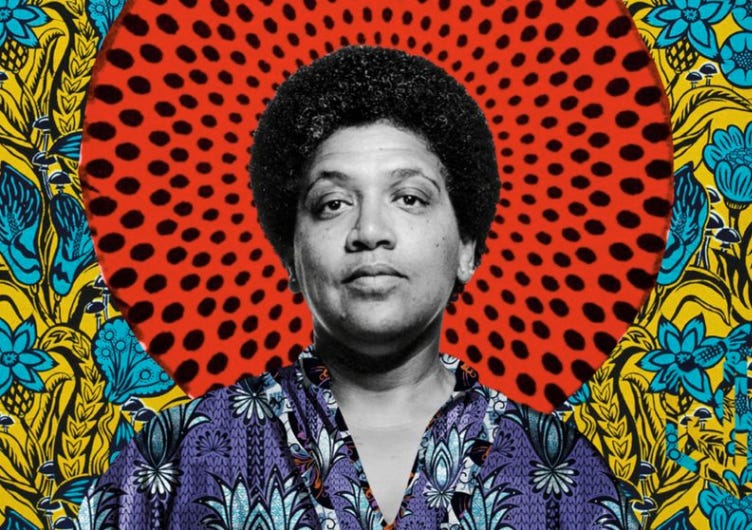
Do not wait for inspiration. You don’t need to be inspired, to write a poem. You need to reach down and touch the thing that’s boiling inside of you and make it somehow useful.
~ Audre Lorde
As writers, we can really struggle with how to say hard / ugly / real things, especially when the Power Structure says we’re being hysterical, overwrought, or exaggerating the truth. But what could be more gentle and innocuous than a sweet little poem? Surely that won’t invite any trouble. Just don’t tell Audre Lorde with her audacious voice and knife-prick of truth.
Power
The difference between poetry and rhetoric
is being ready to kill
yourself
instead of your children.
I am trapped on a desert of raw gunshot wounds
and a dead child dragging his shattered black
face off the edge of my sleep
blood from his punctured cheeks and shoulders
is the only liquid for miles
and my stomach
churns at the imagined taste while
my mouth splits into dry lips
without loyalty or reason
thirsting for the wetness of his blood
as it sinks into the whiteness
of the desert where I am lost
without imagery or magic
trying to make power out of hatred and destruction
trying to heal my dying son with kisses
only the sun will bleach his bones quicker.
A policeman who shot down a ten year old in Queens
stood over the boy with his cop shoes in childish blood
and a voice said “Die you little motherfucker” and
there are tapes to prove it. At his trial
this policeman said in his own defense
“I didn't notice the size nor nothing else
only the color”. And
there are tapes to prove that, too.
Today that 37 year old white man
with 13 years of police forcing
was set free
by eleven white men who said they were satisfied
justice had been done
and one Black Woman who said
“They convinced me” meaning
they had dragged her 4'10'' black Woman's frame
over the hot coals
of four centuries of white male approval
until she let go
the first real power she ever had
and lined her own womb with cement
to make a graveyard for our children.
I have not been able to touch the destruction
within me.
But unless I learn to use
the difference between poetry and rhetoric
my power too will run corrupt as poisonous mold
or lie limp and useless as an unconnected wire
and one day I will take my teenaged plug
and connect it to the nearest socket
raping an 85 year old white woman
who is somebody's mother
and as I beat her senseless and set a torch to her bed
a greek chorus will be singing in 3/4 time
“Poor thing. She never hurt a soul. What beasts they are.”
In 1978, Lorde showed the visceral bones of what was boiling inside her when she wrote Power. Reading her words—even today, even after Trayvon and Floyd, and hundreds of others—stings with the fresh cut, the coppery tang of blood.
Feeling powerless? Got something boiling inside? Let it out.
Shining a light on injustice, grief, and the pain of loss is one of art’s highest callings. And if you’re a writer, it’s not unlike a priestly duty: the sacrament of words, flesh of a story, enlightenment in a turn of phrase.
That doesn’t mean you have to drop your usual genre and go hard on investigative journalism. Think about your favorite book / author. If you read closely, you’ll know where they stand on social issues. Writers (and all the other artists) have always been harbingers of social progress, so don’t be shy. Be like Tolkien and use allegories to point out racial injustice, or emulate Shakespeare’s Macbeth to shine a light on gender roles and power dynamics.
In Death of the Butcher (Camelia Belmont Mysteries, Book 3) Camelia contemplates returning to her native Canada as she struggles to reconcile her oath as an attorney with the increasingly authoritarian U.S. government. That’s just one instance of how my bit of art reflects real life. This isn’t commercial expedience. Art that reflects the challenges of an era are intended to help us explore our own misgivings and motivations, and can clear a path to understanding the emotional toll of facing—and following through on—life-altering, difficult decisions.
Sometimes, our imaginary heroes can even inspire us to follow our better angels. No matter how you infuse your own values into your art, be intentional and fully honest.
Loam, rain, moonrise, and buzzing sunny afternoons
couple with secret seeds.
They rise from the beds,
glow like rubies, carnelians, citrine, golden beryl,
strung on peppery vines,
sinewy and bitter.
He tested one plump orb with his fang,
sharpest white against translucent red.
Its pale juice gushed over his chin,
like the blood of the boy he’d slain just days ago
in the name of Glory.
~ PJ Donison, July 30, 2025
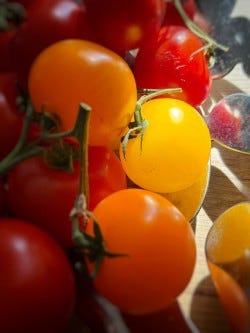
About this poem: When the sun caught these tomatoes, resting in a bowl in my kitchen, they fairly glowed with such gorgeous colours, I knew I had to write something about them. But there’s a vein of grief and suffering right below the surface, likely punching through my subconscious from heart-busting scenes of suffering from LA to Kyiv and lots of places in between.
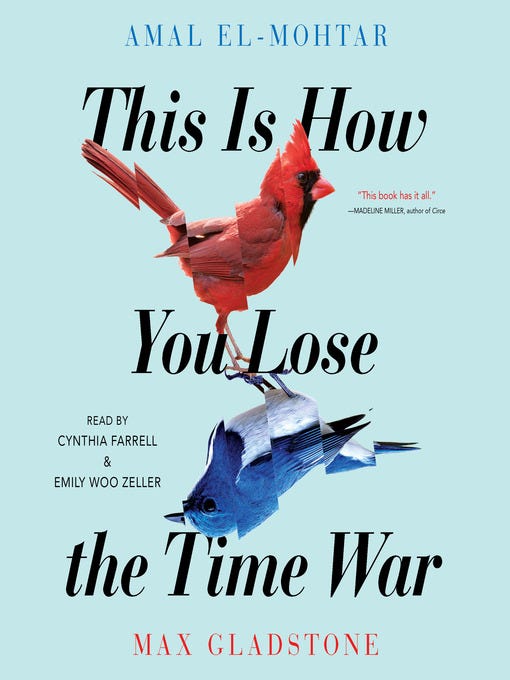
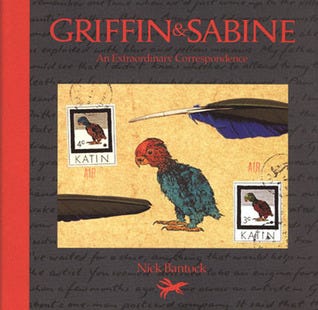
I’ve got a couple of books on the go, but right this minute I’m reading This Is How You Lose the Time War, Amal El-Mohtar and Max Gladstone (Saga Press, 2019). Booklist says it’s “a twisting, sapphic time travel fantasy love story that never stops surprising.” I’ve only just started, but I love an epistolary novel. If you want to read another epistolary novel (say that five times fast) that comes with gorgeous art and removable pieces, check out Griffin & Sabine: An Extraordinary Correspondence (Raincoast Books, 1991) by Nick Bantock.
In this scene, we’re with Dov Saminski on a surveillance job.
Dov lurched forward in the electric cart, headed for the second tee box. Just ahead on the fairway, he saw Karl Kubicek lining up his next shot while the barely legal BareBuns caddie girl poured him a beer. Dov stepped out of his own cart, grabbed a Ping driver from the set of clubs he’d rented, and made the motions of playing golf. His sleeve of balls went untouched, though. He wasn’t here to chase a little white ball all over the place. He was here to watch Kubicek, snap a few photos of the guy cheating on the missus, and be on his way. But it was a slow process, and what should have taken a couple of hours was dragging on a lot longer because Kubicek was a crappy golfer.
Finally, they reached the ninth hole and the end of his subject’s round. Dov pulled his hat down lower on his face as he slotted his cart in behind Kubicek’s at the pro shop. He watched through lowered eyes and mirrored sunglasses as the blond hung on the man’s arm. This was the third time he’d been with the same cart girl. Coincidence, or had he specifically requested this particular girl?
Death of the Butcher is 3rd in the Camelia Belmont Mystery series, and will be released later this year.
Whew! I did it! Substack doesn’t make this the least bit easy (i.e., how TF do you format text???). Hopefully I’ll get the hang of it before I give up. AUGGHGHGH!
Thanks for hanging out and I’d love to hear what you have to say about anything and everything.
See you next time on Serotonin Sunday!
Thanks for reading 26 Letters, Rearranged! Subscribe for free to receive new posts and support my work.
Over the last 9 months, I've missed a lot of important things, including this, your first post, Pamela. Belated congratulations. What varied paths you take! Resistance is something we have to learn to thread in our writing more and more as the world seems to be turning inside out.
Congratulations on your first Substack post, Pamela! I just loved the diversity of what you wrote about (as well as your original poem), at the same time, the consistent theme that runs through your writing. Thank you for having the guts to speak out. Not everyone will agree with our perspectives, but it’s so important—especially now, to be said.


Over the last 9 months, I've missed a lot of important things, including this, your first post, Pamela. Belated congratulations. What varied paths you take! Resistance is something we have to learn to thread in our writing more and more as the world seems to be turning inside out.
Congratulations on your first Substack post, Pamela! I just loved the diversity of what you wrote about (as well as your original poem), at the same time, the consistent theme that runs through your writing. Thank you for having the guts to speak out. Not everyone will agree with our perspectives, but it’s so important—especially now, to be said.